Discours
Speeches
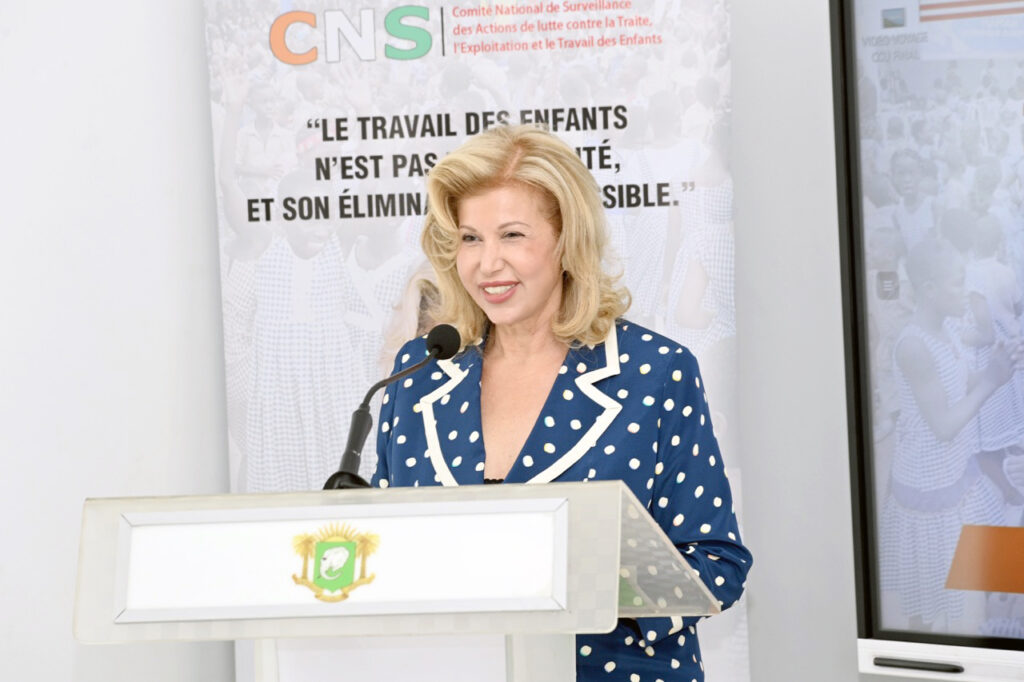
SPEECH BY FIRST LADY DOMINIQUE OUATTARA CHAIRPERSON OF THE NATIONAL OVERSIGHT COMMITTEE FOR ACTIONS TO COMBAT TRAFFICKING, EXPLOITATION, AND CHILD LABOR (CNS)
Ladies and Gentlemen,
I would like to begin by welcoming the distinguished guests here today, and in particular,
- Minister Adama Kamara, Chair of the Interministerial Committee to Combat Trafficking, Exploitation, and Child Labor (CIM),
- Minister Nassénéba Touré, Vice-Chair of the CIM,
- Minister Myss Belmonde Dogo, Executive Secretary of the National Committee to Combat Trafficking in Persons (CNLTP),
- Mr. Junaid Munir, Chargé d’Affaires at the Embassy of the United States of America in Côte d’Ivoire,
- Ms. Amy Rustan Haslett, Senior Coordinator for International Programs at the U.S. Department of State, along with the delegation accompanying her, who have come from Washington to participate in this meeting,
- Mr. Yves Koné Brahima, Executive Director of the Coffee and Cocoa Council,
- Mr. Akébou Sawadogo, Country Director of Save the Children International in Côte d’Ivoire,
- Ladies and gentlemen, members of civil society organizations involved in implementing the CPC partnership, such as Save the Children International, the Association of Women Lawyers of Côte d’Ivoire, and the NGO Dignity and Children’s Rights in Côte d’Ivoire,
- Dear national experts,
- The media,
Ladies and Gentlemen,
I am particularly pleased to be here with you today for the second annual follow-up dialogue on the partnership regarding the Child Protection Compact, “Child Protection Compact” (CPC), which we signed on December 7, 2022, to mark the shared commitment of the United States of America and Côte d’Ivoire to pool their efforts to address child trafficking in our country.
I am happy we have been able to effectively implement this partnership, as well as the encouraging results achieved to date, which further strengthen our efforts on the ground.
To that end, I would like to thank the U.S. Government for providing more than $8.2 million—approximately 4.6 billion CFA francs—to NGOs as part of this project to combat child trafficking, exploitation, and labor.
This is a significant contribution that reflects the United States’s strong commitment to supporting Côte d’Ivoire’s efforts to combat child trafficking.
I would also like to congratulate all the implementing partners of the CPC partnership, Save the Children International, the Association of Women Lawyers of Côte d’Ivoire, and the NGO Rights and Dignity of Children in Côte d’Ivoire, for the activities just presented to us by Mr. Akébou Sawadogo, Country Director of Save the Children in Côte d’Ivoire. Well done on the work carried out by the CPC.
I would also like to congratulate the line ministries that have been actively involved in implementing the CPC partnership’s activities, particularly the Ministry of Employment, Social Protection, and Vocational Training, the Ministry of Women, Family, and Children, the Ministry of National Cohesion, Solidarity, and the Fight Against Poverty, the Ministry of the Interior and Security, and the Ministry of Justice and Human Rights. Well done on your work, Ministers. I ask you to give them a big round of applause.
Ladies and Gentlemen,
At this point in my remarks, I would like to commend the mid-term results of the CPC.
I am also pleased to note that this partnership is being implemented in accordance with the global strategy to combat human trafficking.
It is also aligned with the priority areas of Côte d’Ivoire’s National Action Plan to Combat Trafficking, Exploitation, and Child Labor in its various components, particularly with regard to the “4 Ps”: prevention, protection, prosecution, and partnership.
in the area of prevention:
Since 2011, we have regularly conducted intensive communication and awareness campaigns across the country to inform the public about the dangers of human trafficking and child labor. And I am pleased that today, our people are more aware of this issue.
Furthermore, in this same area, we have built significant basic social infrastructure:
In the education sector: schools, school cafeterias, and housing for teachers in remote rural areas, to increase school enrollment and improve learning conditions for children.
In the health sector: health clinics, maternity wards, and housing for nurses and midwives.
To promote the health and well-being of our rural communities, we are also drilling wells for drinking water to reduce children’s vulnerability to trafficking and child labor.
Regarding the area of protection, which is an essential component of our activities, I am pleased to note that the CPC is actively working to harmonize procedures to take care of child victims and to equip reception centers.
In this same area, the Children of Africa Foundation has built reception and transit centers in Soubre, Ferkessedougou, and Bouake to receive and rehabilitate child victims of trafficking, exploitation, and other forms of violence.
In the same vein, we have also established foster families to provide alternative, community-based care for child victims.
We have also established the National System for Monitoring and Tracking Child Labor in Côte d’Ivoire to track the evolution of this issue in our country through regular data collection.
In the area of law enforcement and prosecution, we note that the CPC places particular emphasis on training judges to ensure more effective enforcement of criminal law.
For our part, we have also enacted legislation to enable the prosecution of traffickers, and we have strengthened our police monitoring system by increasing the number of special brigades tasked with combating trafficking, exploitation, and child labor from five to eleven across the various regions of our country.
With regard to partnerships, the CPC maintains close collaboration with various ministries and all civil society stakeholders.
This aspect is also a key component of our efforts, which is why we regularly sign cooperation agreements with countries in the subregion to combat cross-border trafficking.
We also involve partners from the private sector and civil society. In this same context, the implication of the United Nations agencies—the ILO, UNICEF, and IOM—is central to our strategy to combat child labor.
Ladies and Gentlemen,
Despite our ongoing efforts and the progress we have made, significant challenges remain, particularly with regard to eliminating cross-border trafficking for the purpose of exploitation, as well as providing support to vulnerable families to lift them out of poverty and prevent child labor. Ensuring that all our children attend school is also a major challenge that we are striving to meet, in order to protect them from the risk of child labor.
All these challenges require everyone to increase investments and strengthen partnerships among the various stakeholders.
It is in this context that the CPC Partnership fits, which for us represents a model of collaboration and shared commitment between the United States of America and Côte d’Ivoire in the fight against child trafficking.
Building on this collaborative momentum and our shared achievements, I would like to reiterate my thanks to all stakeholders in the CPC partnership, while inviting them to step up their efforts to maximize results.
Only by doing so will we succeed in permanently eliminating trafficking, exploitation, and child labor in our country.
With that, I hereby declare open the second annual follow-up dialogue of the on the Child Protection Pact (CPC) Partnership.
Autres discours connexes
Others speeches